Alfaiate, a remarkable wine.
The world of wine differs from most other agricultural activities and from almost all other economic activities by living in a very particular microcosm, free from many traditional constraints and bound by others that are uniquely its own. It is a very specific activity, full of characteristics that are difficult to understand and absorb, and therefore to simply replicate what neighbours or a region have done, with grape variety selection decided by personal and validated choices.
But it is not about these wines that I would like to speak today, wines that a decade of consistent quality and deep character has already consecrated, at least among a group of enthusiasts who appreciate authentic wines. I am instead writing about a new wine in the house, a different white wine, deep and full of personality, a wine that revives a Portuguese grape variety, confirms others, and demonstrates that there is plenty of room for those who come from outside, because it is so astonishing and unique that it almost frees itself from points of contact with the normality of the world.
Some people come to wine production through inherited land, a cellar or vineyards, through the continuation of a family tradition, through taste, economic opportunity or passion, perhaps the most frightening word to utter in the world of wine. One way or another, well informed or not, the vast majority of producers and winemakers anywhere in the world have made a life choice based on the desire to make wine and on the desire to be connected to the production of this captivating drink.
Unlike many other professional activities that are entered out of necessity, lack of alternatives, lack of awareness, inertia or academic grades that did not allow other paths, those who enter the world of wine rarely do so without personal will and vocation. Cases of late changes and inclinations are trivial, as are professional shifts into wine by those who trained in other areas and ended up fascinated by this particular universe, so provocative to the senses. Those who are in the world of wine truly enjoy what they do, and this is immediately felt in their gaze, their body language, in most spoken and written discourse, and in the ardour with which topics are discussed that often seem exotic and hardly deserving of attention for most mortals.
As in life in general, some of the characters in the wine universe are more fascinating than others, some denser and others more superficial, some more reserved and others more witty, some more unpretentious and others more intellectual, some more knowledgeable and others more followers, some more studious and others more empirical. Some make history, debate, innovate or revolutionise, others follow traditions, keep the classics alive and preserve the teachings of the past. Some have ideas of their own while others limit themselves to following fleeting fashions or reproducing concepts imported from other producers or other places.
What unfortunately not everyone manages to do, even when included in this immense diversity of concepts, philosophies and perspectives, is to structure a coherent and original project that brings together such varied elements as enthusiasm, research, innovation, authenticity and singularity, combined with boldness and economic rationality. It should not even be necessary to dwell on this last condition, financial reasonableness and viability, but unfortunately, and as tradition would have it, passion can sometimes deceive and betray even those who are usually prudent.

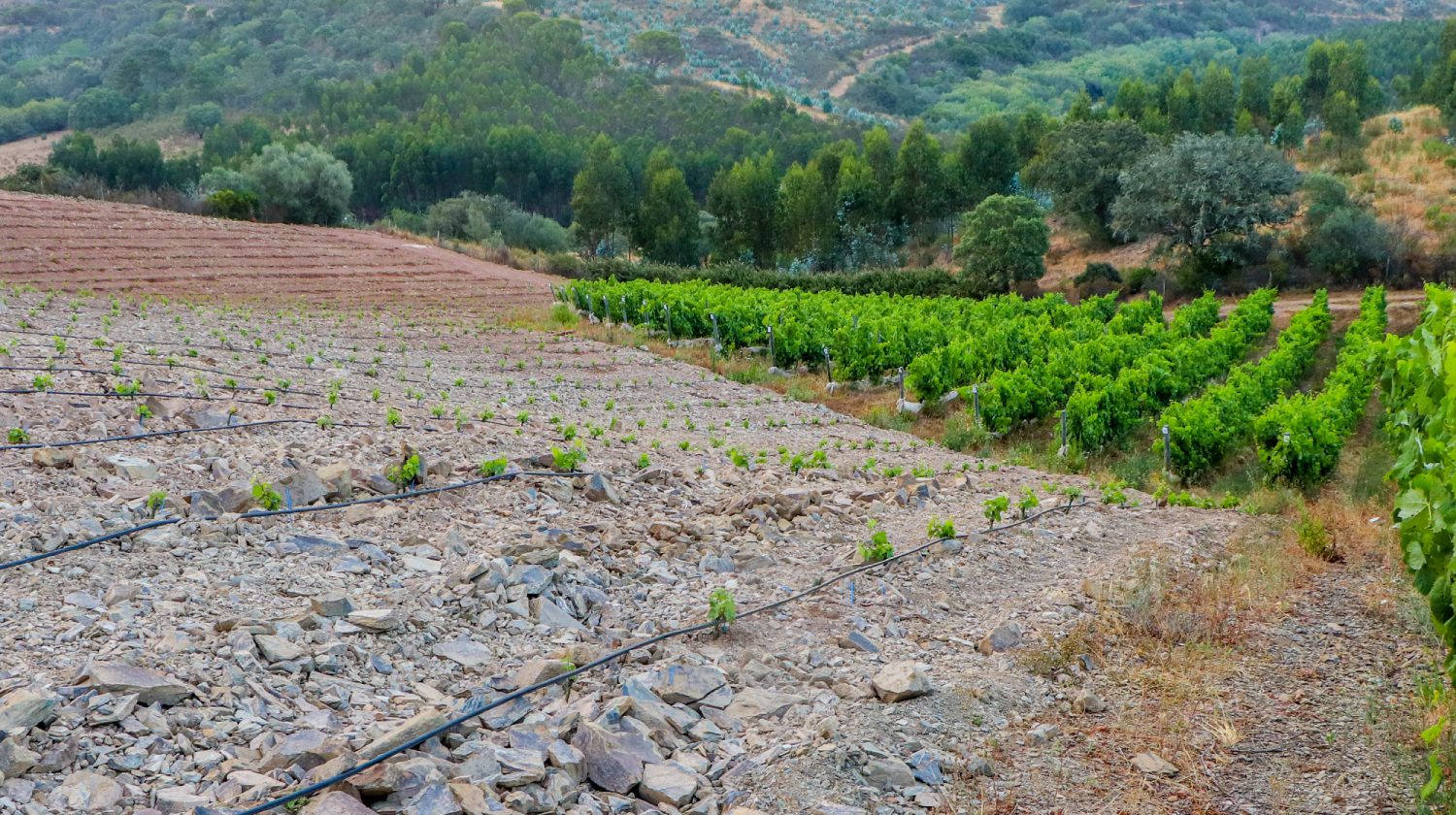
Among the good examples of this blend of creativity, study and respect for the past, to which a touch of boldness and daring is added, is Herdade do Portocarro, a small producer in the Setúbal Peninsula that, despite being close to celebrating its first ten years of existence, still presents itself as a healthy unknown to most Portuguese wine enthusiasts. The vineyards are located in Torrão, in the long belt of rice fields that lines the left bank of the River Sado, slightly south of Alcácer do Sal, on the border between the districts of Setúbal and Évora.
What could be a serious handicap for many producers, because we all know that for most consumers, rightly or wrongly, it is not the same to be identified as a producer from Alentejo or Setúbal, ends up being irrelevant for José da Mota Capitão, the patron, owner and driving force behind the wines of Herdade do Portocarro. The wines are presented and known by their name, personality, quality and deep originality of the project, and are sold in that way without being tied to the legal formalities of appellations of origin. They are original, distinctive, excellent and frankly seductive and pleasant wines.
Until very recently the wines, all reds, were divided between Herdade do Portocarro, a blend of Aragonez, Alfrocheiro and Cabernet Sauvignon, Cavalo Maluco, a blend of Touriga Franca, Touriga Nacional and Petit Verdot, and Anima, a single varietal wine made from the Italian grape Sangiovese. Clear examples of someone who did not limit himself to innovation, while maintaining the teachings of the past.
The wine is called Alfaiate, a wine tailored to the sensitivity of Mota Capitão. The blend results from the combination of the grape varieties Sercial, Galego Dourado, Arinto and Antão Vaz, the first two from their own vineyards in Portocarro, the latter two coming from Alentejo, from the highlands of the Alentejo hills. Arinto and Antão Vaz are harvested very early, when they ensure vibrant acidity and a still minimal alcohol level, accompanying the difficult Sercial, a variety also known as Esgana Cão due to its inflexible acidity.
And then there is still room for Galego Dourado, a nearly lost and widely neglected Portuguese white grape variety, part of the traditional vineyard mix of Carcavelos, and which in times gone by would have been a common variety in the Torrão area, in the same space where Mota Capitão’s vineyards are now planted.
The wine is a powerhouse of austerity, firmness, dryness, dry extract and freshness, an old style wine that reveals an timeless profile. It has none of the tropical fruitiness and firework-like sensations that mark many modern white wines, but it is a serious, deep, mysterious wine that makes you want to drink it. And that is one of the best compliments one can give to a wine.